Academic Heritage

Virginia's World-Class Universities

From the UNESCO-listed grounds of the University of Virginia to the pioneering research halls of Virginia Tech and the colonial classrooms of William & Mary — Virginia's universities are destinations in their own right.

Virginia: A Commonwealth Built on Knowledge

Virginia's relationship with higher education is as old as the Commonwealth itself, and in some respects even older. The College of William & Mary received its royal charter in 1693, making it the second-oldest degree-granting institution in the United States and a founding pillar of American intellectual life. Thomas Jefferson, who graduated from William & Mary before going on to found the University of Virginia in 1819, understood education not merely as a practical preparation for professional life but as the very foundation of democratic self-governance — a conviction that has animated Virginia's academic culture ever since.

Today, Virginia is home to more than 100 colleges and universities, public and private, ranging from the vast research campuses of Virginia Tech and UVA to intimate liberal arts colleges like Hampden-Sydney, Sweet Briar, and Randolph-Macon. These institutions collectively enroll more than 400,000 students annually and contribute tens of billions of dollars to the state's economy through research, innovation, and workforce development. For travelers interested in the intersection of history, architecture, and intellectual life, Virginia's university campuses offer some of the most rewarding and atmospheric visits anywhere in the country.

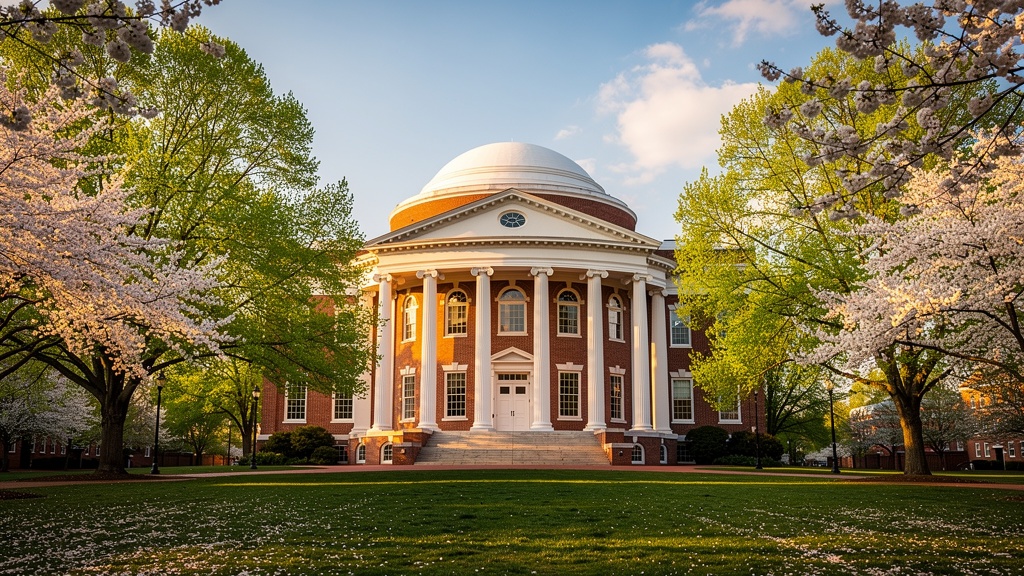
The Rotunda at University of Virginia with red brick columns, white dome, and spring blossoms
UNESCO World Heritage Site

University of Virginia — Jefferson's Academic Village

There is perhaps no university campus in the world that more perfectly embodies the ideals of its founder than the University of Virginia. When Thomas Jefferson designed the "Academical Village" beginning in 1817, he was not merely creating a place of instruction — he was building a physical manifestation of his belief that knowledge, beauty, community, and democratic participation were inseparable. The result, completed in 1826 and designated a UNESCO World Heritage Site in 1987, is one of the most architecturally significant and intellectually charged spaces in American history.

At the heart of the Academical Village stands the Rotunda, modelled by Jefferson on the Pantheon in Rome and scaled to half the original's dimensions. The building's magnificent interior, with its soaring domed reading room divided into two levels by a graceful colonnade, houses one of the most beautiful library spaces in the world. Jefferson positioned the Rotunda at the head of a great lawn — the Lawn — flanked on either side by ten Pavilions housing faculty residences and classrooms, connected by colonnaded walkways and interspersed with formal gardens enclosed by serpentine brick walls. Student rooms, known simply as "Lawn rooms," still house the most distinguished undergraduates, who accept the honor with the understanding that their rooms have neither en-suite bathrooms nor central heating.

Beyond its architectural magnificence, the University of Virginia is consistently ranked among the finest public universities in the United States. Its Darden School of Business, School of Law, School of Medicine, and College of Arts & Sciences regularly appear among the top programs in their respective fields. Notable UVA alumni include former President Woodrow Wilson, Chief Justice Warren Burger, poet Edgar Allan Poe (who attended but did not graduate, famously running up massive gambling debts), journalist Katie Couric, and a remarkable number of American political and intellectual leaders whose names populate the roll of Virginia's governing class.

The university town of Charlottesville, which has grown up around the campus over two centuries, is itself a destination of significant appeal. The downtown pedestrian mall offers an outstanding concentration of independent restaurants, bookshops, boutiques, and live music venues. The Charlottesville wine country, with more than 30 wineries within easy driving distance, extends the appeal of the region considerably. Nearby Monticello and Ash Lawn-Highland (the estate of President James Monroe) make Charlottesville one of the richest destinations for presidential heritage tourism in the United States.

  • Founded 1819 by Thomas Jefferson — the only university he founded
  • UNESCO World Heritage Site (jointly with Monticello) since 1987
  • Consistently ranked #1 public university in Virginia and top 5 nationally
  • Free guided tours available through the Academical Village most days
  • The Rotunda is open to the public; tours run throughout the academic year
Campus Life

Experiencing UVA as a Visitor

Visiting the University of Virginia is one of the great travel experiences that Virginia offers. The Academical Village is not merely a functioning university campus — it is a living work of art and a profound meditation on the meaning of education in a democratic society. Visitors are welcome to walk the Lawn, explore the Rotunda, wander the gardens, and absorb the intellectual atmosphere that Jefferson so carefully crafted. The experience is quite unlike visiting any other university in the world.

The UVA Art Museum, a world-class collection including significant holdings of American art and European old masters, is open to the public free of charge. The Fralin Museum of Art regularly presents major exhibitions that draw from both the permanent collection and external loans. The university's libraries — particularly the Alderman Library and the Albert and Shirley Small Special Collections Library — house extraordinary archival and manuscript collections including Jefferson's original architectural drawings for the Academical Village.

The area around the university is equally rich with intellectual and cultural life. The Virginia Festival of the Book, held in Charlottesville each March, is one of the premiere literary festivals in the United States, drawing hundreds of authors and thousands of readers for a week-long celebration of literature that makes extraordinary use of the university's venues. The Fralin Biomedical Research Institute at UVA Health represents the cutting edge of medical research, conducting breakthrough work in cancer immunotherapy, neuroscience, and infectious disease that has earned international recognition.

  • Charlottesville's Downtown Mall — 9 blocks of pedestrian dining and culture
  • Monticello is just a 10-minute drive from the university grounds
  • Shenandoah National Park is 35 miles west via I-64 and US-33
  • More than 30 wineries within the Monticello AVA wine region
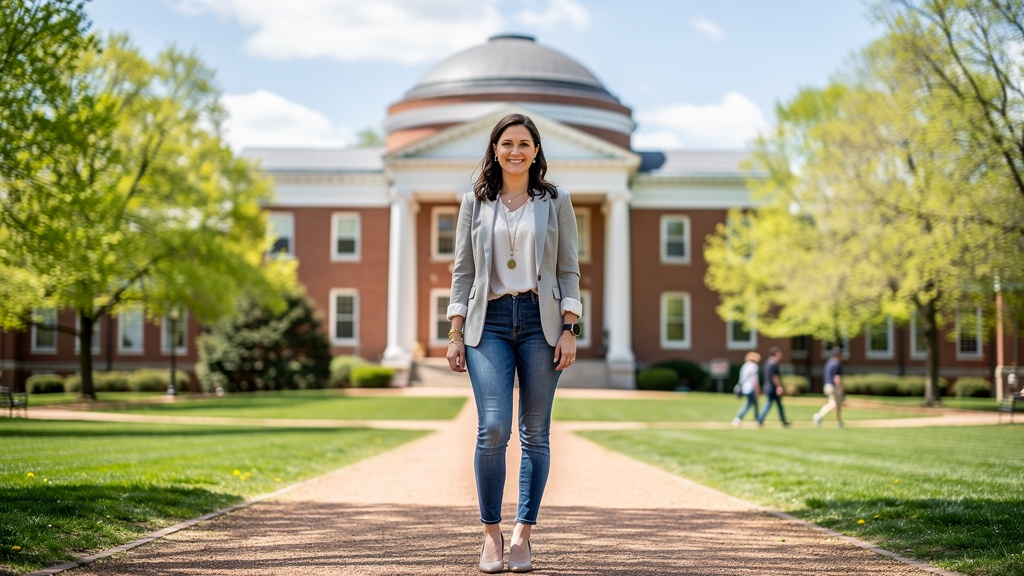
Young woman with dark hair smiling on the historic University of Virginia grounds on a spring day
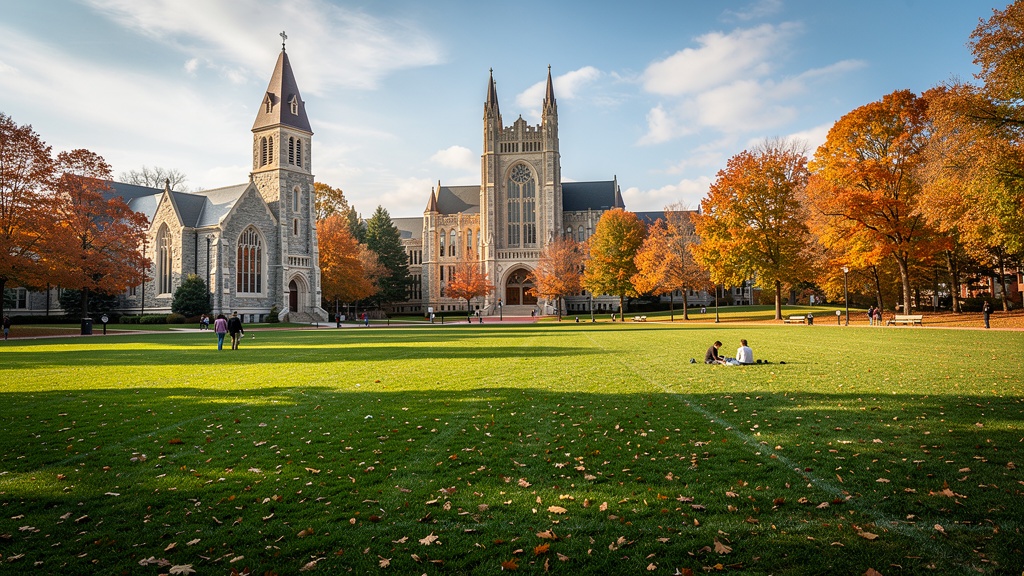
Virginia Tech campus in Blacksburg with Burruss Hall and the Drillfield in autumn
Research Powerhouse

Virginia Tech — Innovation in the Allegheny Highlands

Nestled in the New River Valley in the southwestern corner of Virginia, Virginia Polytechnic Institute and State University — universally known as Virginia Tech — is one of the most dynamic, ambitious, and innovative public research universities in the United States. Founded in 1872 as the Virginia Agricultural and Mechanical College in the small city of Blacksburg, Virginia Tech has grown over 150 years into a comprehensive research university with more than 37,000 students, 300 degree programs, and research enterprise that exceeds $600 million annually.

The Virginia Tech campus is one of the most physically striking university settings in the country. The Drillfield, a large open expanse of grass at the heart of campus, is flanked by buildings constructed in a distinctive Hokie Stone architectural style — a warm, speckled dolomite quarried locally that gives the campus its instantly recognisable character. Burruss Hall, with its classical facade and impressive tower, dominates the north end of the Drillfield and serves as the ceremonial heart of the university. The War Memorial Chapel, a simple and dignified stone building completed in 1960 to honour Virginia Tech's war dead, stands nearby as a place of quiet reflection amid the campus's energy.

Virginia Tech's academic reputation rests particularly on its engineering and technology programs, which consistently rank among the finest in the nation. The College of Engineering is one of the largest and most productive in the country, generating a steady stream of graduates who populate the technology industries of Northern Virginia's thriving tech corridor. The university's programs in architecture, business, veterinary medicine, and the life sciences are similarly distinguished. Virginia Tech operates the largest single-site university innovation campus expansion in U.S. history through its Innovation Campus in Alexandria, Virginia, partnering with Amazon and other technology leaders to create a new hub of applied computing and data science research.

The town of Blacksburg, home to Virginia Tech, is a quintessential American college town — compact, energetic, and intellectually alive. The New River, one of the oldest rivers in the world and a favorite of kayakers and trout fishers, flows through the valley below the campus. The Appalachian Trail crosses the region within easy reach, and the Jefferson National Forest wraps around Blacksburg to provide extraordinary outdoor recreation opportunities that make the university a favorite destination for students who want their academic rigour balanced with outdoor adventure.

  • Founded 1872 — Virginia's largest university by enrollment
  • Top-ranked engineering, computer science, and architecture programs
  • Virginia Tech Innovation Campus in Alexandria — expanding tech leadership
  • Adjacent to the New River Valley and Appalachian Trail corridor
  • Hokie football at Lane Stadium is one of the great college football experiences in the South

The College of William & Mary — America's Second-Oldest University

The College of William & Mary in Williamsburg holds a unique distinction in American higher education: it is the second-oldest college in the United States, founded by royal charter from King William III and Queen Mary II of England on February 8, 1693. It is also one of the most historically consequential universities in American history. Three of the first five presidents of the United States — Thomas Jefferson, James Monroe, and John Tyler — attended William & Mary. The college produced the attorneys and jurists who shaped the American legal system, the politicians who crafted the U.S. Constitution, and the scholars who founded American legal education.

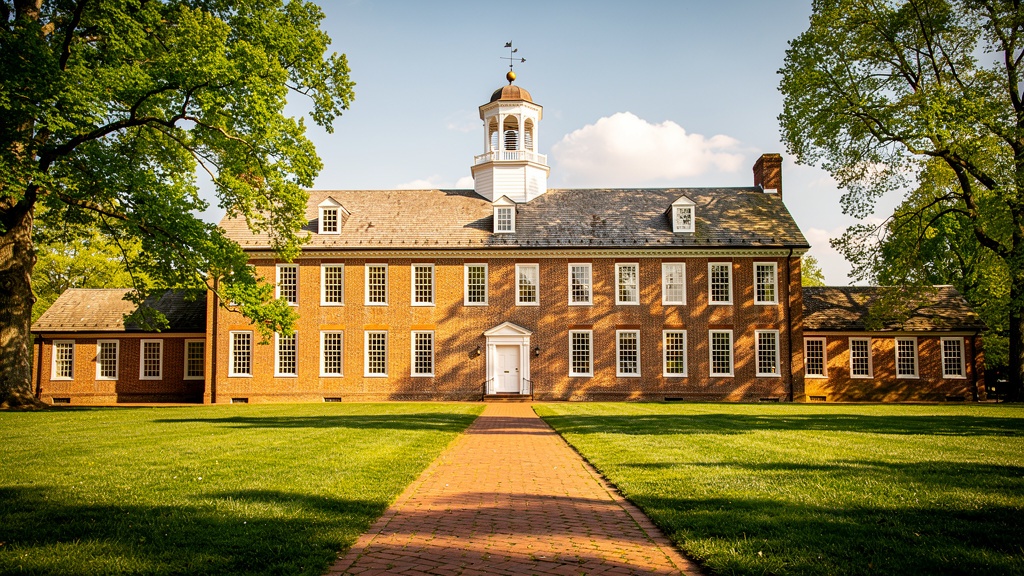
The Wren Building, completed around 1700 and named in honor of the English architect Sir Christopher Wren (though his direct involvement is disputed by historians), is the oldest academic building still in use in the United States. Its warm brick facade, white cupola, and gracious proportions embody the understated elegance of colonial Virginia architecture at its finest. The building has been destroyed by fire and rebuilt three times, yet each reconstruction has respected the original design with remarkable fidelity. Today, the Wren Building's great hall serves as a venue for university ceremonies and remains one of the most atmospheric spaces in American academic life.

The College of William & Mary is formally classified as a Public Ivy — a public university offering academic quality comparable to the Ivy League institutions. Its schools of law, business, and education are consistently ranked among the finest in the country. The Raymond A. Mason School of Business has pioneered MBA education approaches that emphasise ethics, leadership, and global perspective. The William & Mary Law School, one of the oldest law schools in the country, has produced judges, attorneys, and legal scholars who have shaped American jurisprudence at the highest levels.

The college's location within the Colonial Williamsburg historic area creates a campus atmosphere of extraordinary historical richness. Students walk to class past buildings that predate the American Republic, study in libraries that house some of the most important early American manuscripts and printed books, and inhabit a community that has been engaged in the pursuit of knowledge without interruption for more than three centuries. For academic heritage tourists, William & Mary represents an unparalleled destination — a living institution that is simultaneously a working university and a national historic landmark of the first order.

The historic Wren Building at College of William and Mary in Williamsburg Virginia with colonial brick architecture

More Distinguished Virginia Universities

🎨 Virginia Commonwealth University

Virginia Commonwealth University (VCU) in Richmond is one of the most dynamic and rapidly evolving universities in the United States. Its School of the Arts is consistently ranked as one of the finest art schools in the nation — and for good reason. VCU Arts has produced an extraordinary constellation of painters, sculptors, designers, photographers, and performing artists who have shaped contemporary American culture. The school's BFA and MFA programs attract students from around the world, and Richmond's thriving arts scene is in no small measure a product of the creative energy that VCU Arts generates and sustains.

VCU's Medical Center, the largest academic medical centre in Virginia, is a major research institution conducting groundbreaking work in cancer research, transplant medicine, and neuroscience. The university's Monroe Park Campus and MCV (Medical College of Virginia) Campus together create a remarkable urban university that is deeply woven into the fabric of Richmond's cultural and economic life. The Institute for Contemporary Art, designed by Steven Holl and opened in 2018, is itself an architectural masterpiece — a glass and concrete structure of startling beauty that has become one of Richmond's most celebrated landmarks.

💡 George Mason University

George Mason University in Fairfax, in the Northern Virginia suburbs of Washington D.C., has transformed over the past four decades from a regional commuter school into a major research university of national significance. Named for the Virginia statesman and author of the Virginia Declaration of Rights, George Mason has distinguished itself particularly in economics — the university has produced two Nobel Laureates in Economics and houses the Mercatus Center, one of the most influential think tanks in the United States. The Antonin Scalia Law School has risen to prominence as a center for constitutional law scholarship and the training of conservative legal thinkers.

George Mason's location in Northern Virginia — one of the most economically dynamic regions in the United States, home to Amazon's HQ2, the CIA, the NSA, and hundreds of major defense and technology contractors — creates extraordinary opportunities for student internships, research partnerships, and employment. The university's programs in cybersecurity, data analytics, health informatics, and public policy are particularly well-regarded for their practical relevance to the industries and institutions that cluster in the greater Washington metropolitan area. The Mason Center for the Arts presents a rich calendar of performing arts events that serve both the university community and the Northern Virginia region.

⚖️ Washington & Lee University

Washington & Lee University in Lexington, Virginia, is one of the most distinctive and storied liberal arts universities in the United States. Founded in 1749 as Augusta Academy, the institution was renamed Washington College in 1796 after a generous gift from George Washington and again renamed Washington & Lee in 1870 to honour Confederate General Robert E. Lee, who served as president of the college from 1865 until his death in 1870. Lee's presence on the campus remains deeply felt — he is buried in the Lee Chapel, which serves as the spiritual center of the campus and houses a remarkable collection of Lee family artifacts and Edward Valentine's celebrated recumbent sculpture of Lee in repose.

Washington & Lee's campus is among the most beautiful of any liberal arts college in the United States — a harmonious collection of neoclassical and colonnade buildings arranged on a gently sloping hillside above the Maury River. The law school, formally the Washington & Lee University School of Law, has been continuously educating lawyers since 1849. The undergraduate programs in commerce, journalism, and the liberal arts are deeply respected nationally. The university's famous "Speaking Tradition" — by which all members of the community greet strangers with a smile and a word of greeting — creates a campus culture of remarkable warmth and civility.

🎓 James Madison University

James Madison University in Harrisonburg occupies a stunning campus set against the backdrop of the Massanutten Mountain and the Allegheny Highlands. Founded in 1908 as the State Normal and Industrial School for Women, JMU has grown into a comprehensive university of more than 22,000 students with a particularly distinguished reputation for its College of Business, College of Education, and School of Media Arts and Design. The university's commitment to undergraduate teaching — rather than graduate research as the primary institutional priority — creates an educational environment of unusual quality and personal engagement.

The JMU campus blends original bluestone buildings from the university's early decades with ambitious contemporary architecture in a setting of great natural beauty. Shenandoah National Park is less than 30 miles east, and the Shenandoah Valley town of Harrisonburg is one of Virginia's most vibrant and culturally diverse communities, with a remarkable concentration of independent restaurants, craft breweries, and arts venues that has earned it a national reputation as one of Virginia's best small cities. The Shenandoah Valley Organic farming community, centered around Harrisonburg, produces exceptional local foods that support a farm-to-table restaurant culture of impressive sophistication.

Planning Your Virginia University Campus Visits

Virginia's university campuses are extraordinary travel destinations in their own right — living communities of learning set in architecturally magnificent surroundings, many of them deeply woven into the fabric of American history. Here is how to make the most of your campus visits:

"The university is not a place to fill a bucket, but to light a fire." — attributed to the spirit of Jefferson's vision for the University of Virginia

📅 Visit During Academic Year

Virginia's campuses are most alive and atmospheric during the academic year (September–April). The Lawn at UVA, the Drillfield at Virginia Tech, and the historic area at William & Mary all have a particular energy during term time that is absent in the summer months. That said, summer brings smaller crowds and more relaxed access to campus buildings and facilities, which has its own appeal for visitors primarily interested in architecture and heritage.

🗺️ Book Official Tours

All of Virginia's major universities offer free guided campus tours, typically run by student ambassadors through the admissions office. These tours give insight into campus life, academic culture, and institutional history that is difficult to replicate independently. At UVA, the Rotunda tours led by fourth-year students are particularly highly regarded for their depth and personal anecdote. Book online at least a week in advance during busy periods.

🏈 Football Weekends

For a truly immersive Virginia university experience, plan a visit around a home football game — particularly at Virginia Tech (Lane Stadium) or UVA (Scott Stadium). College football in Virginia is a cultural institution as much as a sporting event, and the tailgating traditions, the campus energy before a big game, and the extraordinary atmosphere inside the stadium offer a genuinely memorable experience of American collegiate culture at its most vivid and passionate.

🎭 Arts & Performances

Virginia's universities are major cultural institutions that present outstanding performing arts events throughout the academic year — often free or very modestly priced. UVA's McIntire Department of Music, VCU's Department of Dance and Choreography, William & Mary's Sinfonicron Light Opera Company, and Virginia Tech's Moss Arts Center all present performances of remarkable quality that are open to the general public. Check institutional websites for schedules and booking information.